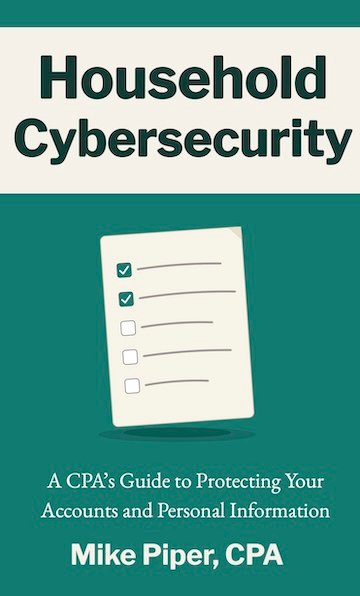

 I’m excited to announce that my latest book is now available on Amazon:
As we’ve discussed here lately, data from the FBI and FTC indicate that cybercrime and fraud have been growing at an alarming rate in recent years. In part, that’s because the tools available to the bad guys are getting better and better every year.
Unfortunately, some people aren’t even aware of the problem. They’re just following the same cybersecurity practices that they were following a decade ago.
Some people do recognize the problem, but they aren’t really sure what they should be doing to protect themselves.
And finally, some people recognize the problem, and they’re actively working on improving their security, but they have a lot of questions about newer tools, what is safe, what isn’t safe, etc.
My goal is for this book to be helpful to all three groups.
Most cybersecurity advice boils down to telling you to be careful: be suspicious of that email, don’t click that link, etc. That is good advice, but it doesn’t go far enough, because it only works if you get it right every single time, for the rest of your life.
A primary theme of this book is that, whenever possible, we want to reduce the degree to which your security depends on making the right judgment, in the moment. The goal is to put protections in place that hold up even when somebody in the household makes a mistake. Because, eventually, somebody in the household will make a mistake.
It’s similar to what we do with saving and investing. A plan that relies on somebody remembering to make manual retirement account contributions every month is much less likely to be successful than a plan in which retirement account contributions are automated. In both cases, the idea is to create a system to reduce our dependence on perfect behavior.
The Focus
As is hopefully clear from the title, this isn’t a book about enterprise cybersecurity. Rather, the question at hand is: what does an ordinary household actually need to know and do to protect their money and personal information?
If you’ve been reading this blog for a while, you know that cybersecurity isn’t my primary profession. But I’ve spent considerable time studying the subject: I’ve earned CompTIA’s Security+ certification, ISACA’s Cybersecurity Audit Certificate, and the AICPA’s Information Security & Cyber Risk Certificate.
The book’s guidance is grounded in recommendations and frameworks from relevant government agencies (NIST, CISA, and the UK’s NCSC), as well as the Center for Internet Security.
Still, the perspective I’m bringing to this subject is that of a CPA and financial planner. The book is specifically focused on what households can do to reduce their risk of fraud, account compromise, or other forms of financial harm.
A Broader Goal
I also have somewhat of a broader goal here. While the book itself is entirely focused on what the reader can do to protect themselves and their loved ones, I’m also hoping that this book can be one small piece in a broader shift toward normalizing cybersecurity discussions as part of financial planning discussions — no different than tax planning, for example.
As it stands right now, most general-audience personal finance materials don’t discuss it at all. Most financial professionals don’t discuss the topic with their clients. Financial planning training materials don’t cover it.
Cybersecurity gets left out, because it’s considered a “tech” topic rather than a personal finance topic.
That’s fine for the people who have a loved one who is savvy on these topics and willing to personally coach them. But most people don’t have that. Most people, even people trying really hard to make sure their finances are in order, are getting little to no information about cybersecurity and fraud prevention. And I believe that gap is a contributing factor to the dramatic increase in fraud that we’re seeing.
And so I hope this book will also be useful to financial professionals who recognize that cybersecurity and fraud prevention are increasingly relevant to the households they serve, but who aren’t sure what they should be telling clients.
Table of Contents
Introduction: An Epidemic of Fraud
Part One: The Threat
1. What Does a Thief Need to Access Your Financial Accounts?
2. Know Your Opponent
3. We Need Protective Policies, Because Mistakes Happen
Part Two: Fundamental Cybersecurity Concepts
4. You Are the CISO (Chief Information Security Officer)
5. The CIA Triad
6. Cryptography Basics
7. Understanding Authentication
8. Password Strength
Part Three: The Tools
9. Password Managers
10. Authenticator Apps
11. Passkeys
12. Physical Security Keys
Part Four: Policies
13. Account Configurations
14. Device Security
15. Network Security
16. Security Maintenance
17. Responding to a Cybersecurity Incident
18. Protecting Vulnerable Loved Ones
Conclusion: Layers of Protection
If you think the book might be helpful to you or a loved one, please pick up a copy:
Household Cybersecurity: a CPA’s Guide to Protecting Your Accounts and Personal Information
And if you do find it helpful, please consider posting a review on Amazon!
What is the Best Age to Claim Social Security?
Read the answers to this question and several other Social Security questions in my latest book:
 | Social Security Made Simple: Social Security Retirement Benefits and Related Planning Topics Explained in 100 Pages or Less |
Disclaimer:Your subscription to this blog does not create a CPA-client or other professional services relationship between you and Michael Piper or between you and Simple Subjects, LLC. By subscribing, you explicitly agree not to hold Michael Piper or Simple Subjects, LLC liable in any way for damages arising from decisions you make based on the information available herein. Neither Michael Piper nor Simple Subjects, LLC makes any warranty as to the accuracy of any information contained in this communication. The information contained herein is for informational and entertainment purposes only and does not constitute financial advice. On financial matters for which assistance is needed, I strongly urge you to meet with a professional advisor who (unlike me) has a professional relationship with you and who (again, unlike me) knows the relevant details of your situation.
You may unsubscribe at any time by clicking the link at the bottom of this email (or by removing this RSS feed from your feed reader if you have subscribed via a feed reader).